
Views: 165 Author: Site Editor Publish Time: 2026-06-24 Origin: Site


Scaffolding fleet managers and safety directors face immense pressure today. You must constantly balance upfront equipment costs against strict OSHA compliance. Long-term structural durability also demands your daily attention. Traditional solid sawn and LVL wood planks remain common across many commercial job sites. However, forward-thinking contractors are aggressively transitioning to metal alternatives. This shift happens for good reason. Wood poses hidden degradation risks. Metal provides predictable, long-term stability.
This article provides a clear, evidence-based evaluation of both materials. We will determine which option delivers better lifecycle return on investment. You will learn how material choices impact operational safety directly. We will also explore structural reliability under harsh environmental conditions. Equipment procurement shapes project profitability entirely. Bad choices lead to dangerous accidents. Smart investments protect your crew and your budget simultaneously. Our goal is to guide your next fleet upgrade decision confidently.
Lifecycle Cost: Wooden planks offer lower upfront CapEx but require frequent replacement due to rot and damage; steel delivers a lower total cost over a 5–10 year horizon.
Safety & Compliance: Steel inherently mitigates the hidden risks of internal wood decay, reducing liability and simplifying OSHA compliance inspections.
Operational Efficiency: Engineered steel components (like built-in hooks and latches) eliminate the need for overlapping and custom cleating required by traditional wood boards.
Decision Rule: Wood remains viable for short-term projects or environments where materials are rapidly destroyed (e.g., heavy masonry), whereas steel scaffold planks are optimal for long-term fleet investments and strict safety environments.
Contractors cannot afford equipment failures. A single scaffold collapse brings devastating consequences to your company. OSHA heavily regulates platform construction to prevent these disasters. Compliance directly impacts your bottom line and reputation. We must evaluate platform lifecycles through a highly practical business lens.
OSHA sets strict guidelines for platform deflection. Standard regulations mandate deflection cannot exceed 1/60th of the platform span. Inspectors also heavily regulate overhang limits and maximum load capacities. Scaffold grade wood must meet specific grading agency standards continuously. Unfortunately, wood deteriorates over time naturally. Deteriorating equipment increases citation risks rapidly. Liability jumps whenever inspectors find cracked or damaged boards on your deck. Your safety team must inspect every single board prior to assembly. This manual inspection process burns valuable labor hours. It also relies heavily on subjective visual judgment.
Procurement teams often default to wood automatically. They focus heavily on its initial low price point. This short-sighted mindset ignores significant ongoing operational costs entirely. Wood requires continuous safety culling on the job site. Your crews must discard boards showing rot, severe splits, or deep structural checks. Storage damage also drains your budget quietly. Improperly stacked wood warps quickly in damp environments. You must constantly purchase replacement boards to maintain inventory levels. Over a five-year period, these replacement costs compound dramatically. We encourage you to look far beyond the initial purchase order. You must evaluate the long-term financial drain of disposable assets.
How do you measure a successful scaffolding platform? A viable system must fulfill several strict criteria simultaneously.
Worker safety remains paramount across all conditions. The surface must provide consistent slip resistance.
The platform must guarantee zero deflection failure under rated loads.
The material must endure severe environmental wear without weakening structurally.
The investment must provide a measurable ROI within three to five years.
Meeting these rigid benchmarks requires careful, deliberate material selection.
Wooden boards have supported construction crews for centuries globally. Solid sawn lumber and Laminated Veneer Lumber (LVL) dominate the legacy market today. They still offer specific advantages for certain specialized trades. However, you must understand their structural limitations thoroughly.
Wood remains widely used in specialized trades today. Residential builders frequently rely on wooden platforms for light-duty framing. You will also see them deployed in highly corrosive chemical environments. Certain industrial acids quickly degrade metal components. Heavy masonry provides another extremely common use case. Masons drop heavy mortar, bricks, and concrete blocks continuously. This brutal activity ruins any board rapidly. Contractors prefer using cheaper wood when they expect rapid material destruction. They view the boards as fully disposable consumables.
Wood boasts a significantly lower initial purchase price. This lower barrier to entry appeals strongly to smaller contractors. Legacy crews also appreciate familiar handling characteristics. Your workers know how to cut and modify wood on the fly. They can easily tailor wooden boards for custom corners. They manage awkward structural spaces easily using basic carpentry tools.
Despite familiar benefits, wood introduces major safety vulnerabilities.
Wood shows extreme vulnerability to moisture, dry rot, and fungal decay.
Splintering and warping occur frequently after prolonged sun exposure.
Boards lose structural integrity over time due to repeated loading cycles.
Internal decay remains completely invisible from the surface level.
Crews must practice strict overhang management continuously.
Wood requires precise cleating or wire binding to remain secure. You must secure boards properly to prevent dangerous lateral slippage. A loose wooden board presents a critical fall hazard for anyone above.
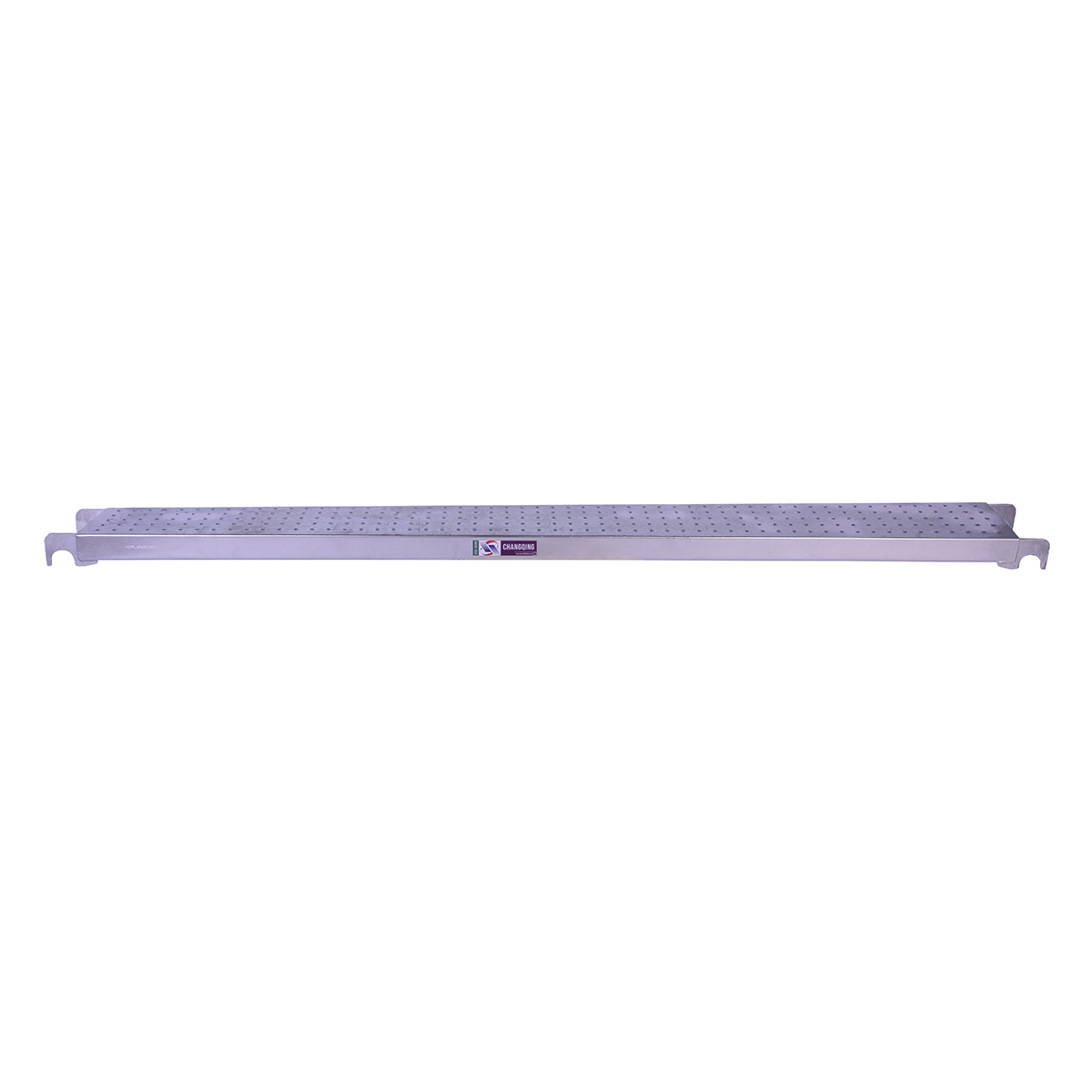
Commercial construction demands engineered reliability. Metal platforms deliver consistent performance across massive job sites. Manufacturers design these components specifically for heavy industrial use.
Manufacturers build these boards from high-yield galvanized steel. This material offers total fire resistance. You do not worry about welding sparks igniting the deck below. Steel also provides superior weatherproofing. It absolutely does not absorb rain or snow. More importantly, it delivers a standardized, predictable load capacity. Engineers can calculate exact stress tolerances safely.
Modern metal systems include built-in safety mechanisms. These features reduce human error during assembly significantly.
Engineered designs often feature a steel plank with hooks to accelerate erection times. This design allows secure, immediate attachment to tubular ledgers. It connects perfectly to system scaffolding ledgers too. This design completely eliminates dangerous overhangs. You no longer worry about workers stepping on unsupported ends. The hooks snap directly over the tube, locking the deck firmly in place.
Wind uplift creates major hazards on high-rise projects. A plank with wind latches solves this severe issue entirely. The latch prevents uplift during high-wind conditions. It secures the platform firmly to the frame. You do not need to rely on secondary wire tie-downs. This speeds up your dismantling process significantly.
Slips and falls remain leading causes of job site injuries. A high-quality non-slip scaffold platform protects your crew daily. These decks feature dimpled or stamped tread designs. Manufacturers punch these perforations from the bottom up. The perforations prevent water pooling on the working surface. They maintain excellent grip in heavy rain or winter snow.
Large commercial sites require massive equipment inventories. Uniform dimensions ensure predictable storage. You can stack metal units perfectly without awkward gaps. Transport becomes highly efficient on flatbed trailers. Standardized sizing allows rapid assembly across sprawling project footprints. You eliminate the guesswork inherent in variable wooden dimensions.
You must compare these materials across primary performance metrics directly. We evaluate load capacity, durability, and ergonomics below.
Performance Metric | Wooden Boards | Metal Platforms |
|---|---|---|
Load Capacity | Variable; weakens progressively with age and moisture absorption. | Consistent; maintains factory-tested heavy-duty ratings securely. |
Weather Resistance | Absorbs water, expands, freezes, and cracks internally. | Galvanized finish prevents rust, rot, and water absorption. |
Average Lifespan | 1 to 3 years under standard commercial use. | 10+ years with proper handling and routine inspections. |
Fire Resistance | Highly flammable; susceptible to welding sparks. | Non-combustible; ideal for hot work environments. |
Wood offers highly variable load capacity. A brand-new LVL board easily supports heavy loads initially. However, it weakens considerably with age. Moisture absorption degrades the internal wood fibers rapidly. Microscopic fractures develop after repeated heavy loading. This leads to unpredictable deflection under stress.
Steel offers consistent and tested capacity. It maintains its specified heavy-duty load rating perfectly. This rating persists throughout its entire lifecycle. The capacity only changes if the unit becomes physically deformed. A dented or bent metal unit requires immediate replacement. Otherwise, it delivers identical strength on day one and day one thousand.
Wood absorbs water like a sponge. This absorption dramatically increases its physical weight. In winter, absorbed water freezes and expands. This freeze-thaw cycle cracks the lumber internally. The average commercial lifespan rarely exceeds one to three years. Your exact replacement cycle depends heavily on job site abuse.
Steel excels in harsh outdoor environments. Hot-dip galvanization prevents surface rust effectively. The metal absolutely does not absorb water. It resists most standard construction chemicals well. You can expect a commercial lifespan exceeding ten years easily.
Wood feels lighter initially when perfectly dry. Workers handle dry lumber with relative ease. However, it becomes incredibly heavy when waterlogged. A wet board becomes cumbersome and dangerous to pass overhead. Moisture weight causes rapid crew fatigue.
Metal features a heavier baseline weight. This weight depends entirely on the specific steel gauge used. This constant weight requires proper crew training. You must teach safe lifting techniques to prevent back injuries. However, the weight remains exactly the same regardless of weather. Workers face no heavy surprises after a massive rainstorm.
Upgrading your fleet requires careful strategic planning. You cannot simply swap thousands of components overnight. You must navigate several transitional challenges safely.
Transitioning a massive fleet requires significant upfront capital. Financial departments often push back against large initial expenditures. We recommend executing phased rollouts logically. You might replace wood on primary working decks first. Later, you can upgrade the secondary access levels. This strategy spreads the capital expenditure across multiple financial quarters. It eases the initial financial shock significantly.
You must guarantee strict dimensional harmony. Ensure the newly sourced steel scaffold planks match your existing frames. They must fit perfectly on your ringlock or cuplock ledgers. A mismatched fit creates immediate structural instability. Always request engineering samples before placing bulk orders. Test the fitment using your oldest existing frames. Ensure the latching mechanisms engage smoothly.
Mixing materials creates severe safety hazards. You must prevent the unsafe mixing of wood and metal on the same working level. Wood and metal rarely share the exact same thickness. This difference creates mismatched deck heights immediately. Uneven surfaces introduce severe trip hazards for your crew. You must maintain uniform deck height always. Segregate your storage yards strictly by material type. Train your logistics team to ship uniform packages to job sites.
While wood offers short-term savings, it presents long-term challenges. The continuous replacement cycle drains operational budgets steadily. Escalating safety liabilities make it a poor long-term investment. Wood belongs on short-term jobs or highly destructive masonry sites.
For commercial scaffolding fleets, the choice becomes abundantly clear. Industrial contractors and safety-first construction firms require dependable assets. Upgrading to galvanized steel represents the mathematically sound choice. It also proves operationally superior in almost every scenario. Predictable safety directly protects your bottom line.
Take action to improve your fleet today.
Audit your current scaffolding inventory for cull rates.
Calculate your annual replacement spend on damaged lumber.
Identify project zones experiencing the highest equipment turnover.
Request a pilot quote for a localized metal upgrade package.
Train your yard staff on proper metal component inspection protocols.
A: Yes. High-quality metal units meet and often exceed strict OSHA load and deflection standards. When installed properly, they provide consistent, factory-tested structural integrity. You must still follow all OSHA guidelines regarding secure placement, maximum load limits, and regular visual inspections to ensure full regulatory compliance continuously.
A: Metal options typically cost two to three times more upfront than standard LVL boards. However, this initial multiplier quickly offsets itself. Metal lasts over ten years, while wood requires replacement every one to three years. You realize significant financial savings well before the five-year mark.
A: No. Manufacturers design these units specifically to enhance surface traction. They feature stamped or dimpled tread patterns. This perforated design allows water to drain instantly. It provides superior grip for work boots, significantly outperforming wet or algae-covered wooden boards in adverse weather conditions.
A: You should never mix them on the exact same working level. Wood and metal feature different material thicknesses. Mixing them creates uneven walking surfaces and dangerous trip hazards. Industry safety standards strongly recommend maintaining uniform deck heights to protect workers from accidental falls.


