
Views: 0 Author: Site Editor Publish Time: 2026-09-22 Origin: Site


Extending the working platform of a scaffold system safely requires precise component selection. The wrong extension bracket compromises structural integrity and site productivity simultaneously. Project managers and procurement teams face a constant challenge. You must balance worker accessibility, load requirements, and spatial constraints when selecting cantilevered extensions. Over-specifying wastes capital and increases unnecessary tower weight. Under-specifying creates severe safety hazards and workflow bottlenecks.
This guide provides a technical evaluation of the one-board versus two-board configurations. We detail load dynamics, spatial applications, material finishes, and procurement criteria. You will understand exactly how cantilever physics impact vertical standards. We break down the ergonomic differences between platform widths. Finally, we establish strict inspection protocols to drive an evidence-based purchasing decision for your next project.
Application Specificity: A one-board hop-up bracket is optimal for tight spatial tolerances and basic personnel access, whereas a two-board hop-up bracket is required for material staging and dual-worker mobility.
Structural Requirements: Two-board configurations introduce higher cantilever loads on the primary scaffold standard, strictly requiring tie-bars and careful Safe Working Load (SWL) calculations.
Lifecycle ROI: Selecting a galvanized hop-up bracket over a painted hop-up bracket significantly reduces long-term maintenance costs and mitigates corrosion in harsh environmental conditions.
Vendor Accountability: Sourcing components from a certified scaffolding manufacturer ensures strict adherence to international load testing, metallurgical standards, and precise dimensional tolerances.
Scaffold systems rarely align perfectly with complex building facades. Architectural features create dangerous gaps between the main platform and the wall. Workers face severe fall risks if these gaps exceed regulatory limits. You must bridge this void safely. The kwikstage hop-up bracket solves this exact problem. It extends the working platform closer to the building facade. You achieve this without erecting an entirely new scaffold bay. This strategy saves massive amounts of time and material on site.
The captive wedge-fixing mechanism defines this system. It integrates directly with standard v-pressings on the vertical standard. You slide the wedge into place and strike it firmly with a scaffold hammer. This bolt-free assembly guarantees rapid deployment. It eliminates lost nuts and bolts on busy sites. The connection remains rigid under dynamic movement. Workers trust the stability of the cantilevered platform immediately because the wedge locks tighter as load increases.
Operational outcomes improve drastically upon installation. Workers stop overreaching to access the facade. Ergonomics for bricklaying and rendering improve instantly. Repetitive strain injuries drop. Site productivity rises. You keep the workforce focused on the task rather than their balance. The platform extension provides a secure, level footing directly adjacent to the workface.
Safety and edge protection integration remain non-negotiable. You cannot simply extend a platform and leave it open. Hop-up brackets feature built-in spigots. These spigots accept standard handrails easily. You must also install toe-board brackets. These clips secure timber boards along the edge. They prevent heavy tools and debris from falling onto lower levels. Full edge protection compliance is mandatory for all cantilevered extensions.
To ensure a safe cantilevered extension, site teams must follow a strict installation sequence:
Inspect the v-pressings on the vertical standard for damage or debris.
Align the bracket's wedge housing with the target v-pressing at the correct platform height.
Insert the wedge and apply a firm hammer strike to lock the component in place.
Install the required timber or steel scaffold boards across the brackets.
Insert the handrail standards into the built-in spigots on the end of the brackets.
Attach the toe-board clips and secure the perimeter toe-boards.
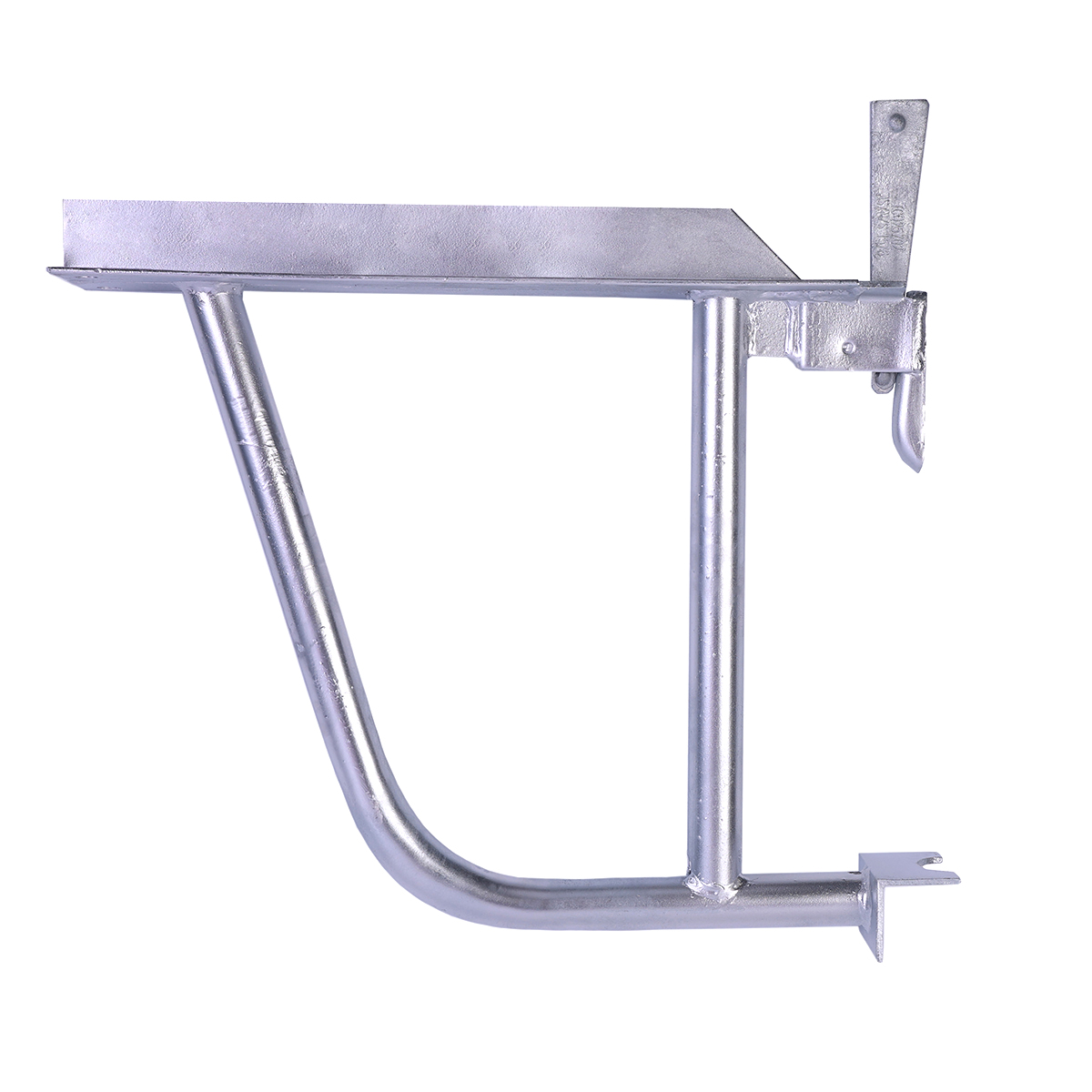
The one-board hop-up bracket serves a highly specific function on site. It extends the platform by a single board width. This dimension typically measures 225mm. The profile remains highly streamlined. It weighs very little compared to wider variants. Scaffolders can carry multiple units up the tower easily. Installation takes mere seconds per bracket. This efficiency accelerates the overall scaffold erection timeline.
Light-duty access defines its ideal use case. You deploy this bracket primarily for inspection tasks. It works perfectly in tight urban alleyways. Narrow property lines often restrict main scaffold widths. This bracket provides just enough room for a worker to stand safely. It keeps the cantilevered weight against the facade to an absolute minimum. Painters, window installers, and safety inspectors rely heavily on this configuration.
However, strict limitations exist. You cannot stage heavy materials here. A 225mm width does not support brick packs safely. It cannot hold mortar tubs alongside a standing worker. If you place tools on this narrow platform, lateral movement stops. The worker becomes trapped by their own equipment. You must strictly enforce load limits. Treat this configuration purely as a personnel access route. Never use it as a primary material loading zone.
Site managers typically approve the one-board configuration for the following trades:
Facade inspectors conducting visual surveys.
Painters requiring minimal equipment at the workface.
Window installers working with lightweight frames.
Sealant applicators navigating tight architectural recesses.
When site demands increase, you require the two-board hop-up bracket. This component accommodates two standard 225mm boards. The total platform extension reaches approximately 450mm. This extra width changes the structural dynamics completely. The bracket features reinforced structural gussets. These thick steel plates support the extended moment arm. They prevent the bracket from buckling under heavy, sustained loads.
Masonry and cladding installation demand this exact setup. A bricklayer needs room to operate comfortably. They also need materials staged at waist height. This bracket provides the necessary square footage. You can stack bricks safely against the inner edge. You can position mortar boards within easy reach. Workflow efficiency peaks in this configuration. Dual-worker mobility becomes possible for complex facade installations.
This increased capacity introduces strict operational limitations. The component weighs significantly more. Installation requires careful handling. More importantly, you must install additional structural bracing. The extended cantilever creates severe torsional twisting forces on the vertical standards. You must use tie-bars. These steel bars link the ends of the brackets together. They prevent the platform from spreading or collapsing under dynamic loads. Skipping tie-bars guarantees structural failure.
The tie-bar installation process requires strict adherence to safety protocols:
Position the two-board brackets at the required height and lock the wedges.
Align the tie-bar pins with the corresponding holes on the outer edge of the brackets.
Drop the tie-bar into place, ensuring it sits flush against the bracket frame.
Verify that the distance between the brackets remains perfectly parallel before laying the boards.
Cantilever physics dictate scaffold safety entirely. When you extend a platform outward, you create a bending moment on the vertical standard. The extended distance of a two-board bracket exponentially increases this force. A one-board bracket applies minimal leverage. The primary standard easily absorbs this minor load. A two-board bracket pulls aggressively against the v-pressing. The engineering must account for this leverage.
Safe Working Load (SWL) ratings differ drastically between the two models. You must calculate both static and dynamic loads accurately. Static loads include stacked bricks, mortar tubs, and stationary tools. Dynamic loads involve workers walking, turning, and dropping materials. A two-board setup handles higher static loads by design. However, the dynamic forces magnify the bending moment significantly. You must consult the manufacturer's technical data sheet. Never guess the SWL on a cantilevered platform.
Facade proximity drives your bracket selection process. Modern architectural protrusions complicate scaffold erection. Balconies, deep cornices, and varying cavity widths require adaptable solutions. A one-board setup navigates tight protrusions easily. It slips past minor obstacles without requiring tower modifications. A two-board setup bridges wider cavities effectively. It brings the worker directly to the recessed workface.
Platform width directly impacts worker speed and comfort. Tool accessibility improves exponentially with more space. Repetitive reaching motions destroy worker shoulders and lower backs. A wider platform brings heavy materials closer to the worker. This reduces physical fatigue. It accelerates project timelines naturally. Ergonomics matter just as much as raw load capacity. A comfortable worker makes fewer mistakes.
Site errors cause catastrophic component failures. The most common mistake involves severe overloading. Workers often treat a one-board bracket as a material loading bay. This exceeds the SWL instantly. The wedge mechanism can shear under this stress. The v-pressing can tear directly from the standard. You must train site teams to respect specific load limits. Visual warning tags help enforce these rules.
Bracing requirements are mandatory for wider platforms. You cannot skip tie-bars on two-board configurations. Without tie-bars, the brackets spread outward under heavy load. The timber scaffold boards slip through the resulting gap. The entire platform collapses. Tie-bars lock the brackets into a rigid, unified frame. They neutralize the lateral spreading forces completely.
Pre-use inspection protocols prevent accidents before they happen. Inspect the wedge-locking mechanism daily. Check for weld fatigue at the v-pressing interface. Look for hairline cracks in the steel. Ensure the bracket remains perfectly straight. Discard any bent or distorted components immediately. A deformed bracket has already lost its structural integrity. Do not attempt to hammer it back into shape.
Specification | One-Board Bracket | Two-Board Bracket |
|---|---|---|
Platform Extension Width | Approx. 225mm | Approx. 450mm |
Primary Application | Personnel access, inspection | Material staging, masonry |
Structural Gussets | Minimal | Heavy-duty reinforced |
Tie-Bar Requirement | Not required | Strictly mandatory |
Cantilever Leverage | Low bending moment | High bending moment |
Your choice of material finish impacts long-term asset lifecycle management directly. You must balance upfront capital expenditure against ongoing maintenance costs. The environment where you deploy the scaffolding dictates this decision. Moisture, salt air, and chemical exposure destroy unprotected steel rapidly. You must select a finish that withstands your specific operational conditions.
The painted hop-up bracket offers a lower initial purchase cost. Manufacturers apply an industrial paint coating over the raw steel. This finish suits dry, short-term, or indoor projects perfectly. However, paint chips easily during transit and assembly. Hammer strikes on the wedge mechanism destroy the paint layer instantly. Once exposed, the raw steel rusts rapidly. Rust compromises the structural integrity of the cantilever over time.
The galvanized hop-up bracket provides superior durability and longevity. The hot-dip galvanization process submerges the steel in molten zinc at temperatures exceeding 450 degrees Celsius. This creates a deep metallurgical bond. The zinc coating resists rust and chemical degradation aggressively. It withstands heavy hammer strikes and harsh weather conditions. This finish delivers a much higher ROI for rental fleets. It dominates long-term exterior deployments in coastal or industrial environments.
Maintenance and storage requirements differ entirely based on the finish. Painted brackets demand covered, dry storage facilities. Moisture destroys them quickly if left outside between jobs. You must touch up chipped paint regularly. Galvanized components offer ultimate storage flexibility. You can store them outside in the rain without fear of rapid oxidation. They require virtually zero maintenance between deployments.
Environmental Factor | Painted Finish Performance | Galvanized Finish Performance |
|---|---|---|
Coastal / Saline Air | Fails rapidly; severe rust | Excellent resistance |
High Moisture / Rain | Requires constant touch-ups | Zero degradation |
Impact Resistance | Chips easily under hammer strikes | Absorbs impact; self-healing zinc |
Storage Requirements | Strictly indoor / covered | Outdoor storage acceptable |
Component failure is not an option on a live construction site. You must source from a highly reputable scaffolding manufacturer. Look for strict quality assurance standards immediately. ISO 9001 certification forms the absolute baseline. The manufacturer must also comply with BS EN 12811-1, AS/NZS 1576, or your regional equivalent. These standards guarantee the bracket can handle the stated loads.
Metallurgical traceability guarantees structural integrity. Load-bearing cantilever components require high-yield steel. Verify the use of Q235 or Q345 grade steel. Request official mill certificates before purchasing. If a vendor cannot prove their exact steel grade, walk away. Inferior steel bends under dynamic loads. It snaps without warning during winter temperatures.
Supply chain reliability ensures seamless fleet integration. Dimensional tolerances must remain exact across thousands of units. New brackets must fit perfectly with your legacy kwikstage scaffolding fleets. If workers have to force a wedge into a v-pressing, the tolerance is wrong. This compromises the connection. It also causes severe hammer rash as workers beat the components to make them fit.
Consider procurement logistics carefully. Calculate shipping weights accurately for bulk orders. Confirm lead times before project commencement. Always demand comprehensive technical data sheets. You need these documents to support your site safety files. Regulatory inspectors will ask for them. A reliable manufacturer provides load test reports and compliance certificates without hesitation.
When auditing a potential vendor, procurement teams must verify the following criteria:
Availability of independent third-party load testing certificates.
Documented proof of steel grades used in the manufacturing process.
Consistent weld quality verified by visual and non-destructive testing.
Exact dimensional matching with standard kwikstage v-pressings.
Clear warranty terms covering structural defects and galvanization quality.
Audit your current scaffold fleet for dimensional compatibility and weld integrity before the next deployment.
Calculate the exact Safe Working Load (SWL) required for your upcoming masonry or rendering projects.
Request comprehensive technical data sheets and independent load test reports from your shortlisted vendors.
Implement mandatory tie-bar installation protocols for all multi-board cantilever setups across your sites.
A: Safe Working Loads (SWL) vary by manufacturer, bracket width, and the presence of tie-bars. A one-board bracket typically supports light-duty loads for personnel. A two-board bracket handles heavier static loads for masonry. You must strictly adhere to the manufacturer's specific technical data sheet. Never estimate cantilever load limits on site.
A: Yes. Tie-bars are mandatory for two-board and three-board configurations. They link the brackets together horizontally. This prevents the brackets from spreading outward under heavy dynamic loads. Without tie-bars, the scaffold boards can slip through the gap, causing complete platform collapse.
A: No. One-board brackets are designed primarily for personnel access and light hand tools. They lack the structural gussets and platform width required for staging heavy materials. Placing brick packs or mortar tubs on a one-board bracket creates a severe overloading hazard.
A: Yes. Regulatory bodies require full edge protection on all cantilevered platforms. Hop-up brackets feature built-in spigots to accept standard handrail ledgers. You must also install specific toe-board clips to secure timber boards. This prevents tools and debris from falling off the exposed edge.
A: Hot-dip galvanizing provides vastly superior corrosion resistance. The zinc coating bonds metallurgically to the steel, protecting it from salt air and moisture. Painted brackets chip easily, exposing raw steel to rapid oxidation. Galvanized brackets are critical for saline or high-moisture environments to prevent structural degradation.
A: Not always. While kwikstage is a standardized system, dimensional tolerances vary between manufacturers. The wedge and v-pressing dimensions must match exactly. We recommend sourcing from a standardized scaffolding manufacturer. This avoids jamming, loose fits, and compromised structural connections.
A: Hop-up brackets introduce an eccentric cantilever load to the vertical standards. This pulls the tower's center of gravity outward. You may need additional counterweights, structural rakers, or building ties to offset this force. Always consult a scaffolding engineer when adding extensive cantilevered platforms to a freestanding tower.


