
Views: 147 Author: Site Editor Publish Time: 2026-08-20 Origin: Site


The vertical standard serves as the foundational load-bearing backbone of any modular scaffolding structure. It directly dictates site safety and assembly speed. When project managers and site engineers select the correct vertical members, crews erect stable platforms faster and with fewer components. Choosing incorrect lengths creates compounded labor inefficiencies. It inflates transportation logistics, introduces structural buckling risks, and generates massive material waste on site. To maximize project efficiency, contractors need a strict technical framework. You must evaluate site requirements against available material specifications. By analyzing structural integration mechanics, load capacities, and component compatibility, construction professionals determine the exact mix of vertical members required. This ensures optimal structural integrity and project return on investment. Selecting the right gear prevents delays and keeps your workforce safe.
Length Dictates Efficiency: Selecting the optimal mix of lengths (ranging from 0.5m to 4.0m) balances worker handling capabilities with the need to minimize joint connections.
Structural Integrity Relies on Specs: High-quality standards require specific manufacturing tolerances, including minimum 3.2mm wall thickness, 8mm rosette plates, and 3.5mm fillet weld heights.
Modularity Requires Compatibility: True efficiency in modular scaffold parts relies on precise 0.5m rosette spacing and seamless integration with spigots, ledgers, and diagonal braces.
Logistics Impact ROI: The choice of standard length must account for transportation limits, storage footprint, and the physical constraints of the erection environment.
The primary function of the vertical standard is transferring dead and live vertical loads from working platforms down to the base jacks and the ground. As the central weight-bearing column, it must maintain absolute plumb alignment to prevent eccentric loading. The standard acts as the central node for all horizontal and diagonal connections. It absorbs wind shear and lateral forces while keeping the entire framework rigid. On a busy site, the standard takes the brunt of the weight from materials, workers, and environmental factors. If the standard fails, the entire bay collapses. Proper load distribution relies on the standard remaining perfectly vertical. Even a slight deviation from plumb reduces the compressive strength of the steel tube.
When erecting a scaffold, the base out process dictates the success of the load distribution. Scaffolders must ensure the first lift of standards sits perfectly level on the base collars. This initial alignment ensures that every subsequent standard stacked above it transfers weight straight down the tube. Eccentric loads occur when ledgers or brackets apply force outside the center axis of the standard. The rosette nodes handle these shear forces, but the tube itself must resist the resulting bending moments. Understanding this load path helps site supervisors plan heavy-duty loading bays correctly.
Modular systems represent a massive leap in engineering over traditional tube-and-clamp or cuplock vertical systems. A Ringlock standard features fixed 0.5m rosette connection nodes. This fixed interval eliminates human error during ledger placement. It ensures decks are always perfectly level and reduces erection time drastically. The rigid wedge-lock connection provides superior structural stability. It offers higher load capacity compared to traditional friction joints, which can slip under heavy vibration or extreme loads. Tube and fitting scaffolds require scaffolders to measure and level every single ledger with a spirit level. This takes time and relies heavily on the skill of the individual worker.
With a modular system, the geometry is built into the component. Once the base is level, the scaffold builds itself plumb and square. The wedge head of the ledger slides over the rosette and a captive wedge is hammered home. This creates a highly rigid node that resists rotation. Cuplock systems use a top cup that drops down over ledger blades, but they often jam with concrete or debris. The rosette design sheds debris easily and allows up to eight connections at a single node. This flexibility makes it far superior for complex industrial applications where piping and vessels require circular or irregular scaffold footprints.
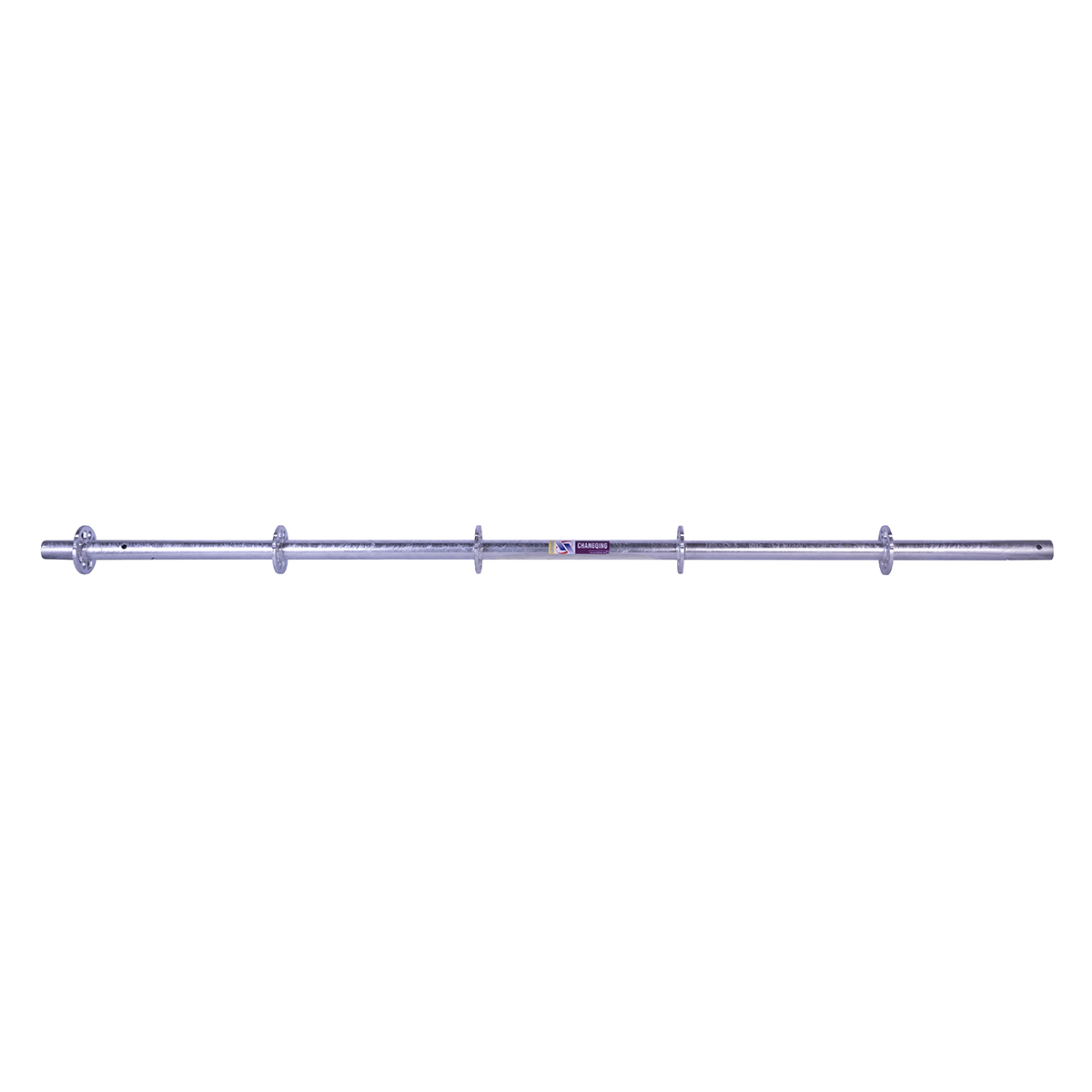
High-performance scaffolding relies on precise manufacturing dimensions. The critical outer diameter typically measures 48.3mm. Material requirements demand high-strength structural steel, such as Q345 or S355 grade. Manufacturers treat this steel with hot-dipped galvanization for long-term corrosion resistance in harsh environments. Weld and rosette specifications are equally critical. You must ensure a minimum 8mm rosette plate thickness and a 3.5mm fillet weld height. This guarantees joint rigidity under maximum load capacities. The wall thickness of the tube itself usually sits at 3.2mm for heavy-duty applications.
The manufacturing process involves cutting the raw steel tubes to exact lengths. Automated welding machines then attach the rosettes at precise 500mm intervals. Any deviation in this spacing ruins the modularity of the system. If a rosette is welded even 2mm out of place, diagonal braces will not fit. After welding, the entire standard dips into a bath of molten zinc. This galvanization process coats both the inside and outside of the tube. It prevents internal rusting, which can silently destroy the structural integrity of the standard from the inside out. Site inspectors should always check the weep holes near the spigots to ensure zinc flowed freely during the coating process.
Length Category | Size Range | Primary Use Cases | Key Advantage |
|---|---|---|---|
Short | 0.5m - 1.5m | Base leveling, guardrails, confined spaces | Highly maneuverable |
Medium | 2.0m - 2.5m | Standard facades, general construction | Optimal ergonomic handling |
Long | 3.0m - 4.0m | Industrial birdcages, large straight facades | Maximizes erection speed |
Short standards serve specific, highly technical roles on the job site. Crews primarily use them for base leveling on uneven terrain. They establish top-level guardrail supports and navigate tight, confined-space installations like internal boiler maintenance. They are highly maneuverable and easy to transport through narrow access hatches. They are ideal for complex geometries. However, using short standards exclusively requires more components to reach target heights. This increases the number of spigot joint connections and drastically extends assembly time. Every joint introduces a slight tolerance stack, which can cause the scaffold to lean if not braced correctly.
When working inside a tank or vessel, scaffolders often pass materials through a 24-inch manway. A 3.0m standard simply will not fit. In these scenarios, 1.0m and 1.5m standards become the primary vertical members. Crews also use 1.0m standards extensively at the top lift of a scaffold to create the final guardrail without leaving excess tube protruding above the working deck. Protruding tubes create snag hazards for crane lines and interfere with facade work. Short standards also help step the scaffold down a sloped grade. By mixing 0.5m, 1.0m, and 1.5m standards at the base, crews can keep the first ledger ring perfectly level across a steep hill.
Medium lengths form the industry baseline for standard facade scaffolding and general commercial construction. They balance ergonomic handling weight, allowing a single worker to safely lift and position the component. They provide efficient vertical height gain. While highly versatile, crews may still require supplementary short standards to hit exact, non-standard deck heights dictated by specific architectural features. A 2.0m standard weighs roughly 10 to 11 kilograms. A scaffolder can easily pass this weight up a chain of workers all day without excessive fatigue.
The 2.0m standard aligns perfectly with standard lift heights. Most working platforms are set at 2.0m intervals to provide adequate headroom for workers. Using a 2.0m standard means the spigot joint occurs just above the deck level. This makes it easy for the scaffolder to install the next standard while standing safely on a fully boarded platform. If you use a 3.0m standard, the joint occurs mid-air, requiring the scaffolder to reach up awkwardly to make the connection. For this reason, 2.0m is the most common length found in rental yards and contractor inventories.
Long standards dominate high-clearance industrial scaffolding, massive birdcage scaffolds, and large-scale straight facades. Utilizing a 4.0m Ringlock Standard maximizes erection speed. It minimizes the total number of vertical joints and reduces the required spigots. The trade-off is maneuverability. They are difficult to handle in tight spaces and require specialized flatbed transport. They present a higher risk of handling injuries if crews do not manage the swing radius properly during installation. A 4.0m standard weighs over 20 kilograms and acts as a giant lever when handled vertically.
When erecting a massive volume birdcage scaffold inside an aircraft hangar or a sound stage, 4.0m standards cut the erection time in half. You eliminate 50% of the spigot connections compared to using 2.0m standards. However, passing a 4.0m tube up a scaffold requires a coordinated effort between two or three workers. Wind also catches these long tubes easily. Scaffolders must maintain a firm grip and use proper lifting techniques to avoid shoulder injuries. Long standards are highly efficient, but they demand a skilled, experienced crew to install them safely.
The structural integrity of a scaffold depends heavily on the relationship between standard length and the unbraced length. The unbraced length is the vertical distance between horizontal ledgers. A standard will fail not necessarily because of its total height, but because the distance between lateral supports allows the steel tube to bow under compression. Engineers calculate safe working loads based on standard height and specific bracing configurations. Tighter ledger spacing increases the overall load capacity of the vertical column. If you leave a 2.0m gap between ledgers, the standard holds less weight than if you place ledgers every 1.0m.
Buckling occurs when the compressive load exceeds the critical buckling load of the steel tube. The rosette nodes act as lateral restraints, but only if ledgers are attached in both the longitudinal and transverse directions. If a scaffold bay is missing a ledger, the unbraced length doubles, and the load capacity of that standard plummets. Site engineers must provide clear drawings indicating exactly where ledgers and diagonal braces must be installed. You cannot simply remove a ledger to create a walkway without consulting the design, as it directly impacts the standard's ability to carry the scaffold's weight.
Industry-standard manufacturing dictates a precise 0.5m interval spacing for rosettes along the vertical tube. This fixed spacing dictates ledger placement and determines safe headroom clearance for workers on the platform. It drives the overall modularity of the system. Scaffolding standards rely on this exact geometry. Diagonal braces intersect perfectly at the nodes, creating rigid triangular trusses that resist lateral sway. If the rosettes were spaced at 0.6m, the entire mathematical model of the diagonal braces would fail.
The 500mm spacing allows for incredible flexibility on site. If a pipe penetrates the scaffold footprint at 1.5m high, the scaffolder can simply install the ledger at the 1.0m or 2.0m rosette to avoid the clash. This node optimization means you rarely need to use traditional tube and fittings to bypass obstacles. The rosettes themselves feature eight holes. Four small holes accommodate ledgers at 90-degree angles. Four larger slots allow ledgers or braces to connect at varying angles, making it easy to build circular scaffolds around storage tanks.
Crews stack standards vertically using bolted or crimped ringlock spigots. Built-in, fixed spigots provide immediate alignment and speed up the stacking process. Loose joint pins offer flexibility but require careful tracking of loose parts. Securing these connections requires locking pins, such as cotter pins or split pins. These pins prevent uplift forces from separating the stack. High winds or crane snags can easily lift a standard off its spigot if the locking pin is missing. Structurally, engineers advise staggering joint placements.
Avoiding joints at the exact same level across adjacent standards prevents the creation of structural hinges across the scaffold face. If every standard in a scaffold has a spigot joint at exactly 4.0m high, the entire structure has a weak plane at that elevation. By mixing 2.0m and 3.0m standards on the base lift, you stagger the joints. The next lift of 2.0m standards will have joints at 4.0m and 5.0m. This staggering technique interlocks the scaffold, making it significantly stronger and more resistant to lateral wind loads.
Logistics play a massive role in standard selection. Transporting 4.0m standards impacts flatbed truck utilization differently than 2.0m or 3.0m lengths. Longer tubes may overhang standard truck beds or require specialized hauling permits. In the yard, stillage packing efficiency and warehouse footprint dictate inventory management. Shorter standards pack densely but require more bins. Long standards demand significant linear floor space. You must plan your transport carefully to avoid paying for empty air on a truck.
When loading a truck, 2.0m standards fit neatly across the width of a standard flatbed. You can stack them high and strap them down securely. 4.0m standards must run lengthwise. If you only need a few 4.0m standards, they take up a massive amount of deck space that could have been used for stillages of ledgers or base jacks. Furthermore, navigating a forklift carrying 4.0m standards through a crowded laydown yard requires wide turning radiuses. Site managers often prefer 2.0m and 3.0m lengths simply because they are easier to move around a congested construction site.
Site managers must evaluate the trade-off between the rapid erection speed of long standards and the physical fatigue associated with heavier components. A 4.0m standard requires significant upper body strength to maneuver into a vertical position safely. Frame the procurement decision around crew size and available lifting equipment on site. If cranes or hoists are readily available, longer standards accelerate the build. For manual handling by small crews, 2.0m lengths maintain steady productivity without exhausting the workforce.
Assess the physical capabilities of your scaffolding crew before ordering long standards.
Determine if a tower crane or material hoist is available to lift bundles of standards to the working deck.
Calculate the total number of spigot connections required for the facade using 2.0m versus 3.0m standards.
Evaluate the wind conditions on site, as handling 4.0m tubes in high winds is extremely dangerous.
Plan rest breaks appropriately if crews are manually passing heavy standards up multiple lifts.
Choose standard lengths based on the specific structure you are accessing. Industrial boilers, tanks, and complex pipe racks favor shorter and medium lengths. These allow crews to navigate obstructions and curve around circular vessels. Commercial high-rise facades with long, uninterrupted straight runs heavily favor longer lengths to build massive surface areas rapidly. A straight run of 100 meters on a commercial building is the perfect environment for 3.0m standards.
In a refinery setting, piping runs in every direction. Scaffolders constantly weave the scaffold through existing steelwork. A 3.0m standard will almost certainly hit an overhead pipe before it stands vertical. Here, 1.5m and 2.0m standards are mandatory. The scaffolder builds the scaffold up to the obstruction, uses a short standard to get just below it, and then uses ledgers to cantilever out and around the pipe. The geometry of the building dictates the inventory you send to the site.
The vertical standard length must align flawlessly with the engineered lengths of ledgers and braces to maintain the system's rigid lattice structure. Ringlock components operate as a unified matrix. If standard spacing or rosette intervals are off by even a few millimeters, diagonal braces will not seat properly into the wedge heads. This compromises the entire structural integrity. The diagonal brace is the most critical component for preventing scaffold collapse. It relies entirely on the precise geometry of the standard.
When a scaffolder installs a diagonal brace, the wedge must drop freely into the rosette slot. If the standard is bent, or if the rosettes are welded incorrectly, the scaffolder has to beat the wedge in with a hammer. This damages the wedge and induces stress into the rosette weld. Over time, this stress causes micro-cracking. High-quality standards ensure that ledgers and braces fit together smoothly, allowing the crew to work quickly without fighting the material.
The initial vertical standard interfaces directly with the base collar and adjustable base jack to establish a plumb foundation. The base collar slides over the jack, providing the first rosette node just above ground level. This allows crews to install the foundational ledger ring. Squaring the scaffold before stacking the primary Ringlock vertical standard sections is mandatory. The base jack handles the uneven ground, while the base collar provides the starting point for the modular geometry.
Once the base collar ring is level and square, the scaffolders drop the first lift of standards onto the base collars. The spigot of the base collar slides inside the bottom of the standard. It is critical that the standard sits completely flush against the base collar. If debris sits inside the tube, the standard will sit high, throwing off the rosette spacing for the entire bay. Crews must inspect the bottom of every standard before standing it up.
Standard lengths directly impact the placement of side brackets, console brackets, and hop-ups used to extend working platforms closer to the building face. You must calculate bracket load paths back to the rosette nodes on the standard to ensure safe working loads on cantilevers. Ensure the standard length accommodates rosette availability at the exact height required for the bracket. If you need a hop-up bracket at 1.5m, you must ensure a rosette exists at that elevation.
Side brackets apply a massive eccentric load to the standard. They pull outward on the top rosette and push inward on the bottom rosette. The standard must have sufficient wall thickness to resist this bending moment. When using 3-board or 4-board brackets, engineers often require additional diagonal bracing on the main scaffold to counteract the pull of the cantilever. The standard acts as the anchor for these brackets, making its structural integrity paramount to the safety of the workers on the extended platform.
Combining Modular scaffold parts from different manufacturers introduces severe structural risks. Varying steel grades, mismatched wall thicknesses, or slight deviations in rosette tolerances lead to loose wedge connections. This causes catastrophic point-loading failures. Implement strict procurement policies and mandate compatibility testing before allowing mixed inventory on site. Just because two components look similar does not mean they share the same load capacity.
A loose wedge connection allows the scaffold to sway. This sway induces dynamic loads into the standards, which they are not designed to handle. If a ledger from Brand A has a slightly thinner wedge than the rosette slot on Brand B's standard, the joint will never lock tight. Site managers must quarantine scaffolding from different suppliers. If mixing is absolutely necessary, a qualified structural engineer must review the technical specifications of both brands and sign off on the compatibility.
The industry acknowledges Layher Allround as the global design benchmark for Ringlock systems. When purchasing standards from third-party manufacturers, you face a critical need to verify compatibility. Focus specifically on rosette dimensions, wedge slot angles, and spigot tolerance. This ensures seamless interoperability without forcing connections with hammers. Many manufacturers claim compatibility, but field testing often reveals tight spigots or misaligned rosette holes.
To verify compatibility, contractors should perform a physical mock-up in the yard before sending new material to a job site. Erect a 4-meter tower using the new standards mixed with existing ledgers and braces. Check how easily the wedges drop in. Measure the diagonal squareness of the bay. Shake the tower to check for excessive play in the nodes. If the new standards pass this physical test, and the manufacturer provides certified material test reports, you can safely integrate them into your fleet.
Avoid the risk of using too many short standards to reach a tall height. This creates a hinge effect with excessive spigot joints, weakening the column's resistance to lateral forces. Conversely, using extremely long standards that protrude dangerously above the required working height creates snag hazards for crane loads and wastes material. Proper planning prevents both of these scenarios.
Site supervisors should generate accurate material lists based on scaffold drawings. If a scaffold needs to reach 6.0m, the optimal build uses two 3.0m standards. Using six 1.0m standards creates five joints in the column, drastically reducing its buckling resistance. Using a 4.0m and a 3.0m standard leaves 1.0m of tube sticking up past the top handrail. This looks unprofessional and interferes with the trades working on the deck. Select the exact lengths needed to finish flush with the top guardrail.
Execute a rigorous pre-erection checklist. Inspect standard straightness; a bent tube loses its compressive strength immediately. Verify rosette weld integrity, ensuring a minimum 3.5mm fillet weld without porosity. Check the hot-dipped galvanization thickness to ensure compliance and site safety. Reject any standards showing deep rust, structural pitting, or deformed rosettes. A damaged standard has no place on a construction site.
Scaffolders should inspect materials as they handle them. If a standard has a dent in the tube, throw it in the cull pile. If a rosette is bent from being dropped off a truck, do not use it. The spigots must also be checked. If a spigot is crushed or bent, the next standard will not slide over it. Regular yard maintenance, including cutting off damaged spigots and replacing them with bolt-in spigots, extends the lifespan of your scaffolding fleet and keeps your crews safe.
To ensure your next scaffolding project runs efficiently and safely, take immediate action on your inventory and planning processes.
Audit your current scaffolding inventory to determine the exact ratio of short, medium, and long standards available in your yard.
Consult with a qualified structural engineer to run load calculations based on the specific unbraced lengths required for your upcoming builds.
Request comprehensive technical specification sheets from certified manufacturers before purchasing new stock, verifying steel grade, weld height, and rosette tolerances.
Train your erection crews on the ergonomic handling differences between 2.0m and 4.0m standards to prevent site injuries and optimize assembly speed.
A: The universal spacing between rosettes is exactly 0.5m (500mm). This fixed interval is critical for modularity, allowing ledgers and diagonal braces to connect at precise engineered angles to form rigid, load-bearing trusses.
A: You connect them by sliding the top standard over the ringlock spigot or joint pin of the bottom standard. You must then insert locking pins, such as cotter pins or specialized bolts, through the aligned holes to secure the stack against uplift forces.
A: Typically, 4.0m is the maximum standard length manufactured. This size offers the best balance between maximizing erection speed on large facades and maintaining feasible transportability on standard flatbed trucks.
A: We strongly advise against mixing components without explicit engineering approval. Variations in steel grade, wall thickness, and rosette tolerances can compromise joint rigidity. Always reference the Layher Allround compatibility standard as the key benchmark.
A: The overall length of the standard matters less than the unbraced length, which is the vertical distance between horizontal ledgers. Shorter unbraced lengths significantly increase the standard's buckling resistance and overall load capacity.
A: The industry standard for heavy-duty applications is a 3.2mm wall thickness. This dimension ensures sufficient structural rigidity and compressive strength to support heavy industrial loads safely without buckling.
A: Built-in, crimped, or welded spigots offer faster, more secure vertical alignment during erection. Removable joint pins allow standards to be used interchangeably as top or bottom pieces, providing greater inventory flexibility.


