
Views: 124 Author: Site Editor Publish Time: 2026-08-28 Origin: Site


Modern modular scaffolding relies on highly engineered, interlocking nodes to maintain structural integrity under extreme loads. System failure often stems from a misunderstanding of individual component functions on the job site. Procurement teams and site managers frequently struggle to accurately estimate and specify the correct ratio of horizontal to diagonal supports. This miscalculation leads to over-purchasing, under-bracing, or compliance violations during site inspections. This technical guide breaks down the precise engineering differences between a Ringlock Ledger and a brace. We detail their distinct load-bearing roles, connection mechanics, and how to correctly specify these critical Scaffolding accessories for your next project.
Distinct Structural Roles: A Ringlock ledger provides horizontal support and defines the bay dimensions, while a diagonal brace prevents lateral movement and structural racking.
Rosette Connection Mechanics: Ledgers lock into the four small, fixed-angle slots on the standard’s rosette, whereas braces utilize the four larger slots to accommodate varying diagonal angles.
Force Distribution: Ledgers primarily handle vertical loads (from decking and personnel) and act as guardrails; braces manage tension and compression forces generated by wind and lateral sway.
Procurement Ratios: A standard modular build requires a significantly higher volume of ledgers compared to braces, though exact ratios depend on the engineered scaffold design and local safety regulations.
The standard 8-hole rosette plate forms the core of this modular system. Manufacturers weld these plates at 500mm intervals along the vertical standard. This engineered node dictates how the entire structure distributes weight and maintains rigidity. Scaffolders rely on this node to build complex geometries without custom fabrication.
The rosette separates connections through specific slot allocations. Four small slots handle 90-degree horizontal connections for ledgers and transoms. Four large slots accommodate variable-angle connections for diagonal braces. This physical separation prevents assembly errors on site. Workers cannot physically force a ledger into a diagonal slot.
Ringlock offers multi-directional versatility. The 8-hole flexibility allows connections at multiple angles. This contrasts sharply with the rigid, perpendicular limitations of Cuplock or traditional frame-and-brace systems. Scaffolders can easily adapt the structure to complex building facades, circular tanks, or irregular industrial layouts.
A hammer-driven wedge pin system secures both ledgers and braces. This mechanism eliminates the need for loose fittings. It reduces assembly time and ensures zero play in the structural joints. A simple hammer strike locks the wedge firmly into the rosette.
Position the standard vertically on a stable base jack.
Align the ledger end with the small slot on the rosette.
Insert the captive wedge pin through the slot.
Strike the wedge pin with a scaffolding hammer to lock the joint.
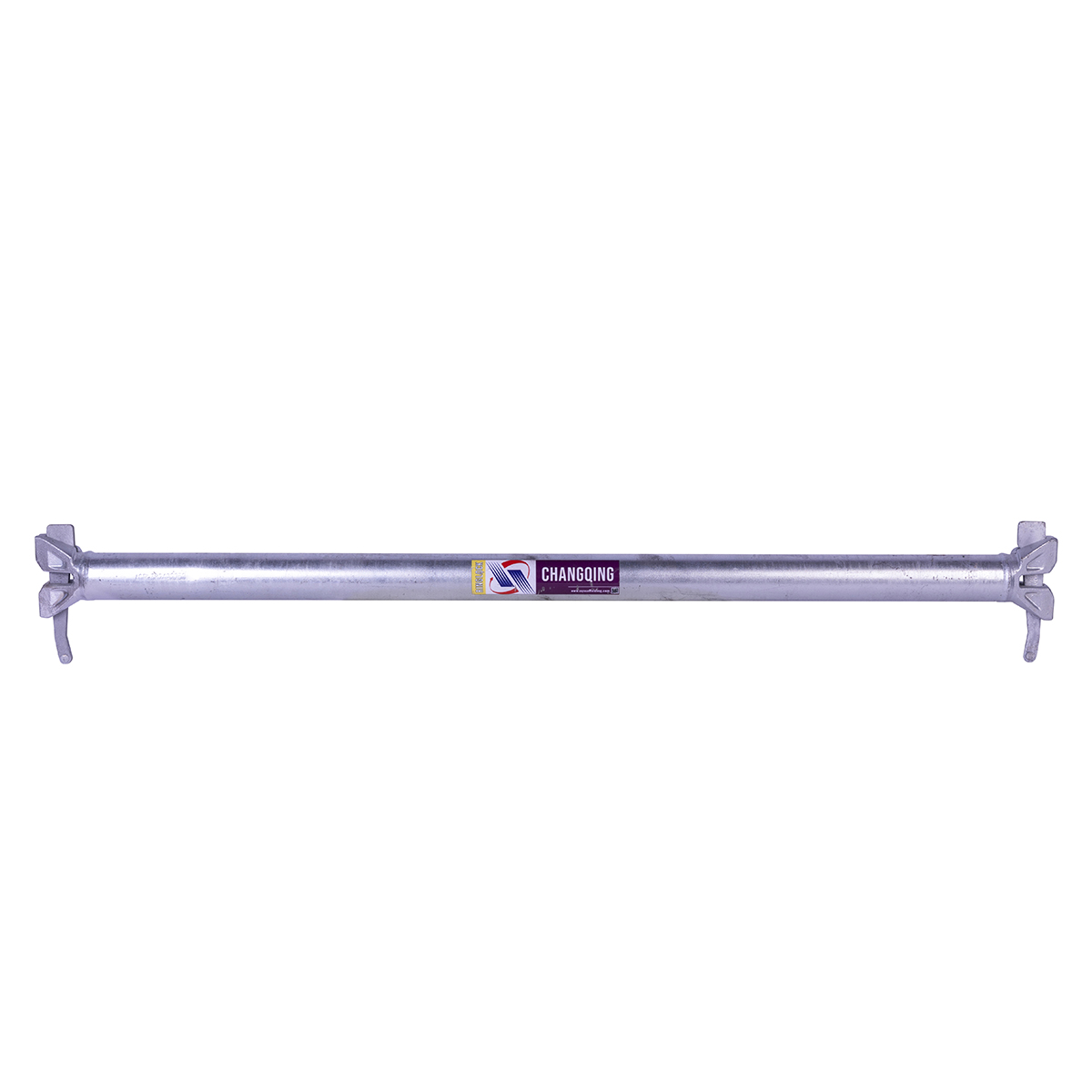
The Ringlock ledger serves as the primary horizontal framing member. It performs a dual role on the scaffold. It acts as a structural tie between vertical standards and serves as a reliable safety guardrail for workers. You will handle more ledgers than any other component during a standard build.
Ledger lengths typically range from 0.73m to 3.07m. These dimensions dictate the exact bay size. They also provide the resting framework for steel planks and other platform accessories. Selecting the correct length determines the working footprint of your scaffold.
You must distinguish between longitudinal ledgers and transverse ledgers, often called transoms. Longitudinal ledgers act as structural ties and guardrails. Transverse ledgers directly support the decking boards. Both utilize the same physical component but serve different structural functions based on placement.
Manufacturers build these components from high-strength galvanized steel, such as Q345 or Q235 steel. The tube diameter and wall thickness directly impact the vertical load-bearing capacity. High-grade steel prevents deflection under heavy personnel loads. Standard tubes measure 48.3mm in diameter with a 3.2mm wall thickness.
The connection design features fixed, forged steel ledger ends. These ends contain captive wedge pins designed for rigid, right-angle seating in the rosette. This fixed angle ensures square, stable bays. The forged ends resist deformation from repeated hammer strikes over years of use.
Ringlock ledgers offer significant logistical advantages. They stack flat, optimizing storage density. This compact footprint reduces transportation costs compared to bulky, pre-welded frame scaffolding. You can fit thousands of ledgers into a single shipping container.
Ledger Length (m) | Weight (kg) | Primary Application |
|---|---|---|
0.73 | 3.1 | Narrow access towers, transverse support |
1.09 | 4.2 | Standard transverse support, stair towers |
1.57 | 5.8 | Short longitudinal bays, heavy load areas |
2.07 | 7.4 | Standard longitudinal bays |
2.57 | 9.0 | Extended longitudinal bays, facade work |
3.07 | 10.6 | Maximum span longitudinal bays, light duty |
The Ringlock brace is the critical component for lateral stability. It prevents the scaffold structure from twisting, swaying, or collapsing under shear forces. Without braces, a scaffold is just a collection of rectangles waiting to fold under pressure.
Braces manage tension and compression effectively. They distribute lateral loads, like wind or dynamic worker movement, diagonally across the scaffold bays. They convert these loads into manageable tension and compression forces down to the base jacks. This load transfer keeps the structure plumb and secure.
The swivel connection mechanics make this possible. The pivoting wedge head, or swivel end, allows the brace to connect at various angles. This angle depends entirely on the bay length and the lift height. The swivel head articulates to match the required geometry perfectly.
The mathematics of the bay brace require precision. Diagonal brace lengths are engineered to correspond precisely to specific combinations of horizontal ledger lengths and vertical standard lifts. A standard lift height is typically 2.0m. You cannot use a brace designed for a 2.07m bay on a 3.07m bay.
Identification and sizing rely on practical on-site safety checks. Manufacturer color-coding systems and stamped labels help scaffolders. They can quickly match the correct Diagonal brace to specific ledger dimensions without guessing. This visual system speeds up erection and reduces dangerous mismatches.
Orientation and placement differ significantly between the two. The ledger requires strict horizontal placement. The diagonal brace requires angled, cross-bay placement to function correctly. You build the box with ledgers and lock the box with braces.
They possess different force mitigation profiles. Ledgers are engineered for bending moments and vertical load transfer. Braces are engineered for axial loads, meaning push and pull forces, to maintain geometric rigidity. A ledger bends under too much weight; a brace buckles under too much compression.
Rosette utilization separates their physical connections. Ledgers use the small holes, while braces use the large holes. This physical difference prevents incorrect assembly on-site. The system forces the scaffolder to build it correctly.
Their impact on the structure varies. Ledgers directly interact with decking, toe boards, and side brackets. Braces operate independently in the vertical plane to support the overall frame. You walk on components supported by ledgers; you rely on braces to keep the whole system upright.
Component density and system complexity also contrast. Ringlock requires 12 to 16 pieces per bay, including ledgers, standards, and braces. Simpler frame-and-brace setups need only 6 to 8 pieces. Ringlock’s higher ledger-to-brace density yields superior load capacity and structural flexibility. You trade a higher part count for unmatched adaptability.
Feature | Ringlock Ledger | Ringlock Brace |
|---|---|---|
Primary Function | Horizontal support, bay sizing, guardrails | Lateral stability, anti-sway, structural rigidity |
Rosette Connection | Small slots (fixed 90-degree angle) | Large slots (variable diagonal angle) |
Load Type Managed | Vertical loads, bending moments | Axial loads (tension and compression) |
End Fitting | Fixed forged blade | Pivoting swivel head |
Calculating component ratios requires a baseline framework. Every standard bay requires multiple horizontal ledgers for structural tying and edge protection. Diagonal braces are typically specified for outer faces and every transverse bay. You usually place them every third to fifth longitudinal bay. This ratio changes based on wind loads and structure height.
Implementation risks and assembly errors can compromise safety. Omitting diagonal braces in continuous runs leads to catastrophic racking. Striking wedge pins too hard or too softly compromises the rigidity of the ledger connection. A loose wedge pin reduces the node's stiffness, allowing the scaffold to sway.
Mitigation requires strict adherence to engineered drawings. You must enforce mandatory post-assembly hammer-strike inspections to verify every node. Supervisors should physically check the wedge pins before signing off on the scaffold tag.
Compliance and safety standards depend on proper integration. Correctly combining these Ringlock components satisfies international scaffolding standards. This includes OSHA, EN 12810/12811, and AS/NZS 1576 regarding load classes and edge protection. Proper bracing is not optional; it is a legal requirement for site safety.
Audit your current yard inventory to ensure you have the correct ratio of ledgers to corresponding diagonal braces before starting a new project.
Implement a strict color-coding or labeling system on site to prevent workers from installing mismatched braces on standard ledger bays.
Mandate a physical hammer-strike inspection of all rosette nodes prior to issuing a green scaffold tag.
Consult a qualified scaffolding engineer to calculate exact wind loads and determine the precise bracing frequency required for your specific build height.
A: No. Ledgers have fixed, rigid ends designed strictly for 90-degree horizontal connections and cannot physically bridge a diagonal gap or pivot to fit the required angle.
A: The exact number depends on the engineered design, but industry best practice generally dictates placing a diagonal brace on the outer face of every third to fifth longitudinal bay, and on every transverse bay, running from base to top.
A: The four smaller holes ensure ledgers and transoms lock at perfect 90-degree angles for square bays, while the four larger holes provide the necessary tolerance for diagonal braces to connect at various angles.
A: Both are horizontal Ringlock components. Ledgers typically run longitudinally (the length of the scaffold) to act as guardrails and ties, while transoms run transversely (the width) to directly support the scaffolding planks.
A: The required brace size is mathematically dictated by the length of the horizontal ledger and the vertical height of the standard's lift (usually 2.0m). Manufacturers often color-code braces to correspond with specific ledger lengths.
A: While many Ringlock systems share standard dimensions (like the 500mm rosette spacing), mixing components from different manufacturers is generally discouraged and often violates safety certifications unless explicitly approved by a qualified engineer.
A: Because Ringlock ledgers and braces are individual, linear tubes without bulky pre-welded frames, they stack exceptionally flat. This compact footprint significantly reduces the physical storage space required in warehouses and optimizes shipping container capacity.


