
Views: 0 Author: Site Editor Publish Time: 2026-09-09 Origin: Site


Dropped objects and edge falls on commercial construction sites present severe liability risks and fatal hazards. These incidents threaten on-site personnel, public pedestrians, and passing vehicles in dense urban environments. Procurement and safety officers constantly face the challenge of sourcing reliable edge protection. They need systems that meet stringent regulatory standards without slowing down the assembly and dismantling phases of complex structures. Traditional methods often rely on wire-tied timber. This introduces human error and structural inconsistency.
The purpose-built ringlock toe board serves as a non-negotiable component of modern modular scaffolding. It provides a continuous, secure barrier along platform edges. This technical guide covers evaluating, specifying, and sourcing these components for enterprise-scale safety. You will learn how proper edge protection integrates with your existing inventory to prevent struck-by hazards and ensure strict compliance across all your job sites.
System Integration: Authentic ringlock toe boards are engineered to lock seamlessly with ledgers, standards, and steel scaffold planks, eliminating the gaps and instability common in traditional tube-and-clamp setups.
Compliance & Liability: Standardizing on high-grade toe boards directly mitigates site liability by fulfilling OSHA, EN 12811, and NASC requirements for edge protection, pedestrian safety, and dropped-object prevention.
Material Durability: Transitioning from timber to galvanized steel toe boards reduces long-term expenses through higher impact resistance, fire safety, and extended lifecycle.
Vendor Selection: Partnering with a certified scaffolding manufacturer ensures component traceability, strict load-testing compliance, and reliable supply for large-scale deployments.
Platform edge protection must meet specific baseline success criteria to be considered effective in the field. The primary function involves the complete containment of hand tools, heavy equipment, construction debris, and raw materials. A functional edge barrier also provides a tactile boundary for workers navigating the platform. When a scaffolder or tradesperson steps backward while focused on an overhead task, the physical resistance of the board against their heel signals the platform edge. This immediate physical feedback prevents accidental falls without requiring the worker to break visual contact with their work.
The physics of falling objects on multi-story builds demand robust containment strategies. A standard two-pound spud wrench dropped from one hundred feet accelerates rapidly, hitting the ground with immense kinetic energy. This force easily penetrates standard hard hats and causes fatal injuries. A properly sized edge barrier interrupts this kinetic chain early. It stops rolling pipes, kicked tools, and sliding masonry debris before they ever leave the working deck. This containment protects lower-level workers and pedestrians walking under the scaffold structure.
Wind adds another layer of complexity to high-rise construction. Strong gusts easily blow lightweight materials off an unprotected deck. The solid vertical face of the board blocks wind currents at the deck level. This prevents loose screws, plastic packaging, and small hand tools from becoming airborne hazards. On coastal projects or high-altitude builds, this wind-blocking capability is a mandatory safety requirement.
Toe boards act as a secondary physical barrier at the foot level. They work directly in tandem with mid-rails and top rails to create a comprehensive fall protection envelope. If a worker slips on a wet, oily, or icy deck, the top rail alone might not prevent a fall. A worker could slide underneath the mid-rail. The foot-level barrier catches the sliding worker, keeping them safely on the platform. This continuous lower barrier proves especially necessary during adverse weather conditions when slip hazards increase significantly.
Global safety authorities mandate exact dimensional and structural requirements for edge protection. Meeting these regulatory baselines requires precision-manufactured components rather than improvised wooden barriers. The core requirements include:
Height Minimums: OSHA regulations stipulate a minimum height requirement of 3.5 inches from the top edge of the board to the platform surface. European standard EN 12811 requires a minimum height of 150mm.
Gap Restrictions: The clearance between the bottom of the board and the walking surface must not exceed 1/4 inch. This tight tolerance ensures that even small fasteners and hand tools cannot slip through the gap.
Force Resistance: The board must withstand a minimum of 50 pounds of downward and outward force. This ensures the component will not buckle or detach if a worker falls against it or if heavy materials roll into it.
Continuous Coverage: The barrier must run the entire length of the exposed platform edge, including corners and access points, leaving no unprotected gaps larger than one inch.
Understanding how edge protection fits into the broader ringlock scaffolding ecosystem dictates the efficiency of your assembly process. Modular systems rely on standardized connections. Every component must interact flawlessly with the surrounding structural members. The edge barrier must integrate with the vertical standards, horizontal ledgers, and the platform decking simultaneously without causing binding or requiring forced fits.
Modern modular boards utilize specific locking mechanisms to secure the barrier to the scaffold frame. Most designs feature built-in hooks or specialized end brackets welded directly to the steel profile. These brackets drop directly over the rosette or rest securely behind the wedge pins of the horizontal ledgers. This engineered connection ensures zero lateral movement. Once installed, the board cannot be kicked outward or shifted along the deck by heavy foot traffic.
This locking mechanism significantly reduces labor time compared to traditional methods. Workers do not need to cut wire, tie knots, or drill screws to secure the barrier. The drop-in design allows a single scaffolder to install edge protection rapidly as they advance along the platform. Dismantling is equally efficient. Workers simply lift the board off the ledger, requiring no special hand tools or wire cutters.
The interface between the vertical barrier and the primary walking surface requires careful evaluation. The board must sit completely flush against a steel scaffold plank. Any dimensional mismatch creates dangerous gaps that violate OSHA and EN standards. The hooks of the plank and the brackets of the board must share the same ledger space without interference. Precision engineering ensures both components seat fully on the tubular support.
Specialized decking requires additional consideration. When using a plank with wind latches, the edge protection must not obstruct the latching mechanism. The wind latch must remain free to engage the ledger to prevent uplift during severe weather. High-quality boards feature cutouts or specific bottom profiles that accommodate the upward swing of the latch. This guarantees that wind uplift protection remains fully functional while edge containment is in place.
Construction sites rarely feature perfectly straight facades. Scaffolding must adapt to complex geometries, including 90-degree corners, internal curves, and irregular building footprints. Modular boards come in various lengths to match the standard bay sizes of the system. At corners, the boards must overlap or meet flush to maintain a continuous barrier. Specialized corner brackets or overlapping end profiles prevent gaps at these critical junctions.
Platform extensions present another challenge. When extending the working deck outward using a ringlock side bracket, the cantilevered section requires full edge protection. The side bracket features its own rosettes or attachment points. The edge boards must connect to these outer points just as securely as they do on the main deck. You cannot leave the extended platform open. It poses the exact same fall and dropped-object risks as the primary structure.
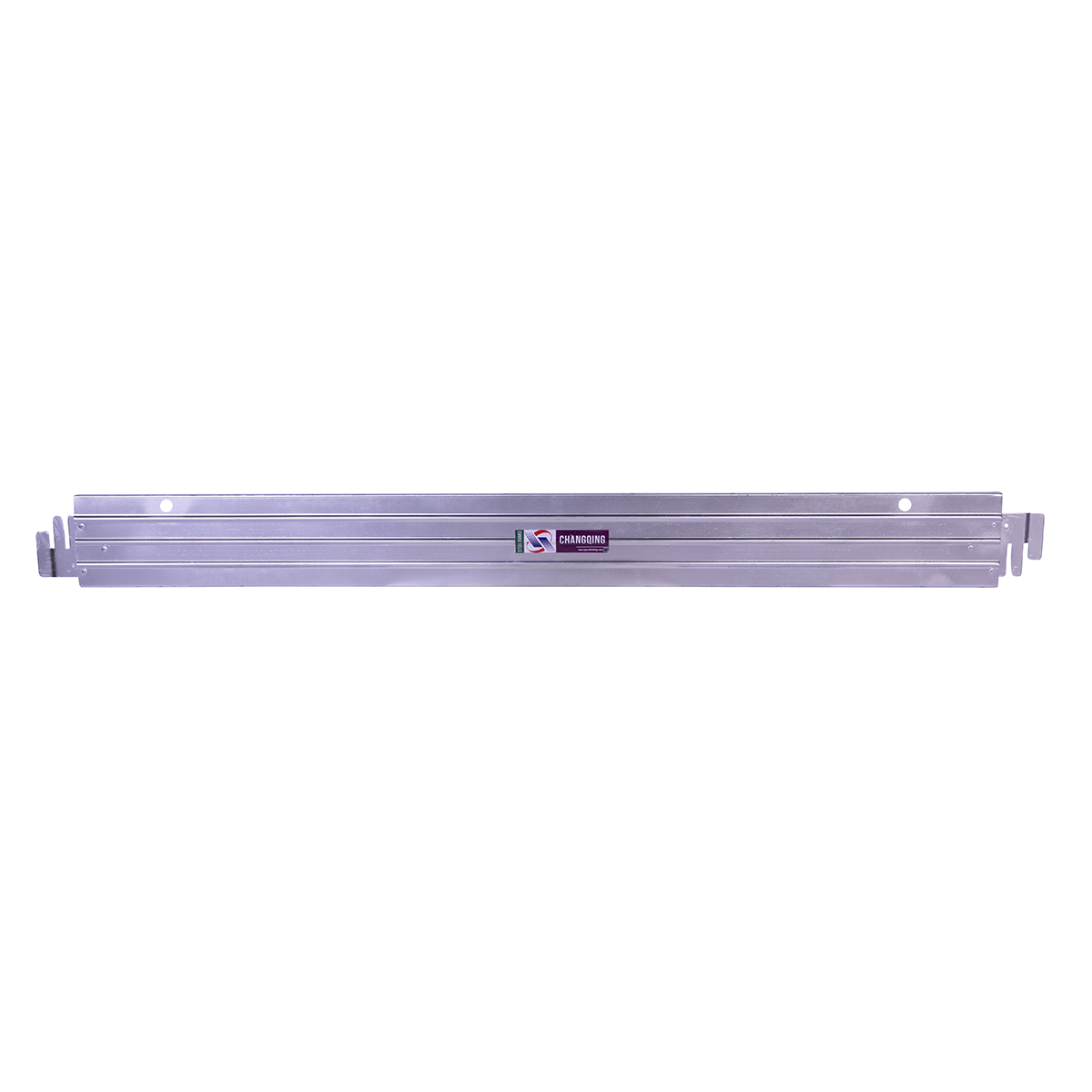
Selecting the right material for your edge protection involves structural and financial trade-offs. Enterprise buyers must evaluate these materials based on longevity, maintenance requirements, and safety performance in harsh field conditions. The three primary materials used in the industry are galvanized steel, aluminum, and timber.
Hot-dipped galvanized steel stands as the industry benchmark for heavy commercial construction. The galvanization process coats the raw steel in a protective layer of zinc. This coating provides exceptional resistance to environmental degradation, preventing rust even in harsh coastal or industrial environments. Steel offers superior impact resistance. It will not easily dent or deform when struck by heavy equipment, dropped masonry blocks, or swinging crane loads.
The load-bearing capacity of steel ensures it easily exceeds the 50-pound force requirement. Furthermore, steel is completely non-combustible. This fire safety aspect is mandatory on sites involving welding, grinding, or hot work. Sparks and slag will not ignite a steel barrier, preventing localized fires from spreading across the scaffold deck.
Aluminum offers a distinct advantage in its weight-to-strength ratio. Aluminum boards are significantly lighter than their steel counterparts. This weight reduction facilitates rapid assembly and reduces worker fatigue during erection and dismantling phases. The lighter weight also reduces the overall dead load on the scaffold structure, which benefits highly engineered, weight-restricted designs like suspended scaffolds.
However, aluminum comes with higher upfront costs. It is also more susceptible to deformation under heavy impact. A dropped steel beam or heavy masonry block might bend an aluminum board, requiring immediate replacement. Buyers must balance the speed of assembly against the potential for higher replacement rates in abusive environments.
Traditional scaffolding often utilizes standard timber boards turned on their edge to serve as toe boards. While this approach utilizes existing inventory, it presents severe limitations. Timber retains moisture, leading to rot and structural degradation over time. Wooden boards are highly susceptible to splitting, especially when secured with nails or wire. A split board loses its structural integrity and will fail under impact.
Fire resistance is a major concern with timber. Wood is highly combustible, making it unsuitable for hot work environments. Additionally, timber requires frequent inspection and high replacement rates. Warped or twisted wood creates uneven gaps along the deck, violating safety regulations. Modern safety standards strongly favor engineered metal solutions over traditional wood.
Material Specification | Impact Resistance | Fire Safety Rating | Weight Profile | Lifespan & Durability | Maintenance Needs |
|---|---|---|---|---|---|
Galvanized Steel | Excellent (Resists heavy strikes) | Class A Non-combustible | Heavy (Requires proper lifting) | 10+ Years (Resists rust and deformation) | Low (Occasional cleaning) |
Extruded Aluminum | Moderate (Prone to denting) | Class A Non-combustible | Light (Reduces worker fatigue) | 5-7 Years (Depending on site abuse) | Low (Inspect for bends) |
Scaffold Grade Timber | Low (Splits under pressure) | Combustible (High risk) | Medium (Varies with moisture) | 1-2 Years (Prone to rot, warping) | High (Frequent replacement) |
Sourcing reliable components requires vetting suppliers beyond just the per-unit price. The structural integrity of your entire platform relies on the quality of its individual parts. A rigorous procurement process ensures you receive equipment that performs safely under extreme site conditions.
You must demand specific certifications from your supplier. A reputable scaffolding manufacturer will operate under ISO 9001 quality management systems. This certification guarantees consistent manufacturing processes across every batch. Request third-party load testing reports to verify the boards meet OSHA and EN force requirements. Independent testing removes manufacturer bias and provides objective proof of performance.
Material mill certificates are equally important. These documents trace the origin and chemical composition of the steel. They confirm the yield strength of the raw material and verify the thickness of the zinc galvanization layer. Proper documentation protects your company during safety audits and incident investigations.
Strict manufacturing tolerances are necessary for modular systems. A poorly manufactured board will not seat correctly on the rosette or ledger. If the end brackets are welded even a few millimeters off-center, the board will bind during installation. This causes system-wide assembly delays as workers struggle to force incompatible parts together with hammers.
Worse, poor tolerances create dangerous platform gaps. If the board does not sit flush against the deck, it fails its primary purpose. Evaluate the manufacturer's welding processes. Robotic welding provides superior consistency compared to manual welding, ensuring every hook and bracket aligns perfectly with the scaffold geometry.
Enterprise projects require massive quantities of components delivered on strict schedules. Assess the manufacturer's production capacity and lead times. A supplier must demonstrate the ability to fulfill large orders without compromising quality control. Furthermore, evaluate their ability to provide custom lengths or specialized components for bespoke project requirements. Reliable supply chain logistics prevent costly project delays caused by missing safety equipment.
Even the highest quality equipment fails if implemented incorrectly. Identifying where edge protection fails in real-world applications helps safety officers enforce better field practices. Proper training and strict inspection protocols are necessary to maintain a safe working environment.
Field-level mistakes often compromise platform safety. A common error involves failing to secure the board properly behind the standard. If the board merely rests on the deck without engaging the locking mechanism, a minor impact will knock it out of place. Workers sometimes leave excessive gaps at corners, creating a funnel for falling debris.
Using incompatible third-party planks also causes issues. If the deck profile does not match the board profile, you cannot achieve a flush fit. Another frequent violation occurs when workers temporarily remove a section of the barrier to sweep debris off the deck and fail to replace it. This creates an immediate, unguarded fall hazard.
Safety officers must implement a standardized pre-shift inspection checklist. This routine verifies the integrity of the edge protection before work begins. Emphasizing scaffolding safety requires active daily monitoring. The inspection should focus on several key areas.
Check for secure seating at every connection point, ensuring hooks fully engage the ledgers.
Inspect the boards for severe deformation or bending that compromises structural strength.
Verify that no gaps exceed the 1/4 inch maximum clearance above the decking surface.
Examine the galvanized coating for deep scratches or early signs of severe corrosion.
Ensure corner transitions overlap correctly without leaving open spaces.
Confirm that wind latches on adjacent planks operate freely without binding against the toe board.
Proper handling prolongs the lifespan of galvanized components. During dismantling, workers must not throw the boards from the upper decks to the ground. Dropping metal components causes severe denting and damages the zinc coating, accelerating rust. Boards should be lowered using hoists, pulleys, or passed down manually.
Storage practices also impact longevity. Stack the boards neatly on wooden dunnage to keep them off the bare ground. Avoid storing them in standing water or highly acidic environments. Regular cleaning to remove wet concrete, mortar, or corrosive chemicals will preserve the galvanization and keep the locking mechanisms functioning smoothly for future projects.
Take the following actions to upgrade your site safety and ensure full regulatory compliance:
Audit your current edge protection inventory to identify and discard damaged or non-compliant timber boards.
Download detailed technical specification sheets from your supplier to verify dimensional compatibility with your existing decking.
Contact a certified manufacturer for a project-specific compliance review and material estimate.
Implement standardized pre-shift inspection checklists focusing on secure seating and gap restrictions.
A: OSHA standards require toe boards to be a minimum of 3.5 inches high from the top edge to the platform surface. European standard EN 12811 requires a minimum height of 150mm. Both standards mandate that the gap between the board and the deck must not exceed 1/4 inch.
A: They form a continuous solid barrier at the deck level. This prevents tools, loose fasteners, construction materials, and trash from rolling off the edge and falling onto public walkways or streets below, eliminating severe struck-by hazards in urban environments.
A: While historically common, timber poses significant compliance and safety risks. Un-secured timber can warp, rot, and split. Purpose-built steel boards feature integrated hooks that lock directly into the modular system, ensuring zero lateral movement and meeting strict load-bearing regulations.
A: It utilizes engineered end brackets or built-in hooks. These hooks drop over the rosettes or rest securely behind the wedge pins of the horizontal ledgers. This design locks the board firmly in place without the need for wire ties or additional fasteners.
A: No. High-quality engineered systems are designed to work together. The toe board profile accommodates the upward swing and locking mechanism of the wind latch, allowing it to operate freely while the board sits flush against the platform edge.
A: Yes. Any platform extension or cantilevered section requires full edge protection. The side brackets feature attachment points that allow the toe boards to secure the outer edge, providing the exact same fall and debris protection as the main scaffold deck.


